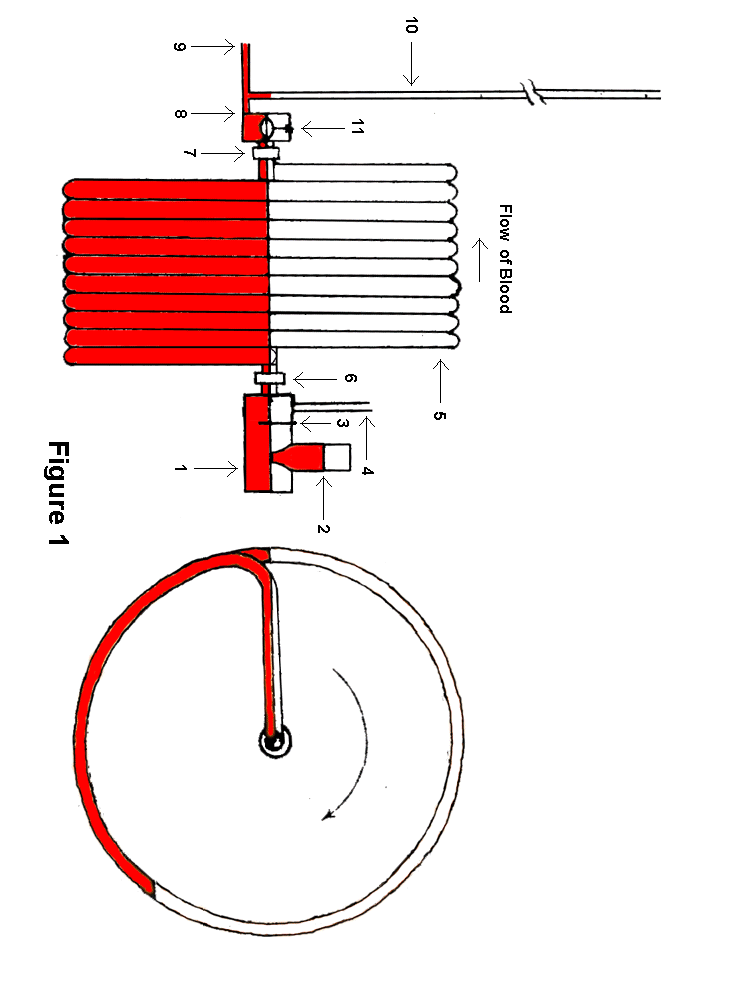
A Heart and Lung Machine
This disclosure describes a mechanical device suitable for performing the functions of a human heart and lungs when these organs are bypassed to facilitate surgery.
Background
Functionally, the heart is only a pump. However, it is a very special pump and cannot be replaced even temporarily by most of the well-known kinds of mechanical pumps. The metal valves and/or pistons of the conventional reciprocating pump would damage the blood by crushing corpuscles. The turbulence in a centrifugal pump would trigger thrombolitic activity in the blood by the large pressure difference inherent in cavitation. The only pump that works is a peristaltic pump, but even these can cause high-speed turbulence, are expensive, hard to clean, and require the replacement of tubing after each use.
For these reasons, a better method of pumping is to closely simulate function of an actual heart and, if possible, to combine pumping with oxygenation.
The function of the lungs is to allow the blood to come into intimate proximity with the atmosphere so that it can give up its carbon dioxide and take on oxygen. Heretofore, this has been accomplished by allowing the blood to run down over stainless steel discs, microporous membranes, or gas permeable membranes.
Such devices have been made to operate satisfactorily, but either their complexity or nonreusabilty make them expensive or difficult to maintain. It is the purpose of this disclosure to describe a simpler solution to these two related problems.
Description
There are three reasons that this device deserves a patent: it is a novel idea, it is a nonobvious application of technology, and it is useful.
Novelty
The novelty of this device lies in three areas: 1) the cumulative pumping force of the coils, 2) the combination of oxygenation with pumping, and 3) the inlet and outlet control equipment.
No heart and lung machine using a design at all similar to this one has ever been used before. This one is novel because it uses a tube of suitable size and material wound in a helix having a horizontal axis about which it can be rotated (Fig. 1) to perform the functions of both the heart and lungs. To operate properly, the helix requires certain auxiliary and control equipment. As these can take many forms without altering the basic claims of this disclosure, only one version of those components that is unique will be described. Instruments and components which will be required for measurement and control and which are common to current heart and lung machines will not be described.
Besides the helix, components essential to the operation of the heart and lung machine described herein are those that supply the blood and the artificial atmosphere to the helix, and those which handle the discharge. To accomplish this, the ends of the helix are connected to rotary tubing joints concentric with the axis of the helix, and thence to closed inlet and outlet tanks. There are connections to the inlet tank for admitting the artificial atmosphere and the venal blood. And there is a float in the outlet tank, which operates a vent in the top, while an outlet in the bottom is connected by means of a flexible tube to an adjustable overflow tank and to the arterial outlet.
Except for means for measuring and controlling the acidity, oxygenation and flow of the blood, which are common to all such devices, a small variable-speed motor, a belt, and pulleys to rotate the helix complete the heart and lung machine.
This device is not, as has been suggested, a simple reapplication of the time-tested Archimedes screw, for that device merely elevated water by means of an enclosed screw. In contrast to our device, each twist of the screw did not compound the pressure, but simply moved liquid in individual units.
Nonobviousness
This design was originally created in the 1950’s. Since then, no design for a heart and lung machine similar to this one has been proposed or used. If the idea were obvious, it would have been thought up long ago.
It is also not obvious to the average person that each coil of the helix actually adds to the pressure generated cumulatively. Thus slow and passive turning creates substantial pumping forces.
Usefulness
While the heart and lung machines in use today are perfectly adequate for hospital purposes in America, they have several disadvantages for less developed countries. First of all, they are not very portable. If missionaries or any other group attempting to improve conditions in third world nations wished to bring a heart and lung machine into the wilderness, they would have a very difficult time with the large machines used currently. On the other hand, this design weighs very little, is relatively small, and can be operated without any electricity at all if necessary. Second, heart and lung machines in their current state have several expensive components that can only be used once before they must be replaced. In impoverished areas, people who need life saving procedures thus are not able to have them, because it costs about five hundred (500) United States dollars to buy these replacement components. In contrast, our design can be reused completely, or the helix can be replaced quickly and inexpensively. All of the incipient research into making PVC or other materials nonreactive to human blood can be applied to our design as well as they can be in conventional designs.
Operation
As indicated in Figure 1, blood in reservoir 1, maintained at the proper level by the make-up supply in bottle 2, flows into the chamber 3 while the desired atmosphere is supplied to chamber 3 through tube 4. The make-up bottle is adjusted to hold the level of the blood at the level of the axis of helix 5, so that as the helix is rotated, as indicated by the arrow, blood will run through rotary joint 6 into the bottom of the first coil as the helix approaches the position shown. As the rotation continues, the artificial atmosphere will be drawn into the top half of the first coil of the helix as the blood in the bottom is moved toward the second coil by gravity and the rotation of the helix. This alternate filling of the bottom of the coils with blood and the top with atmosphere continues until all the coils are so charged and the half-coil of blood first taken in reaches the end of the helix where it is dumped through rotary joint 7 into chamber 8.
If the blood were allowed to flow freely out of tube 9 there would be no back-pressure; as the helix continued to turn, a half-coil of blood and a half-coil of atmosphere would continue to be dumped into chamber 8 with each revolution. However, if the flow of blood from tube 9 is restricted, a back-pressure will begin to build up with two simultaneous results:
(a) The blood in the bottom of each of the coils will be displaced toward the first or intake coiled by an amount proportional to the back-pressure divided by the number of coils (because the hydraulic heads produced across all of the coils will be in series) and;
(b) Blood will rise in tube 10 to a height equal to the hydraulic head.
Now it will be noted that the artificial atmosphere, which will also be discharged into chamber 8, would tend to escape by bubbling up through tube 10. As this would cause foaming of the blood and a change of head, both undesirable if not intolerable effects, a float-controlled vent 11 is placed in the top of chamber 8 to allow the oxygen-depleted atmosphere to escape.
As the helix continues to rotate a secondary effect of the back-pressure will begin to make itself felt: because the intake coil can never fill with blood to a level higher than the constant level held in chamber 3, and because the back-pressure lowers the level to which the blood can rise as it flows down the helix, less blood will be drawn in with each revolution. The flow is thereby inversely related to the back-pressure. Thus for constant speed, the device tends to adjust the flow to hold a constant pressure rather than to build up the pressure to hold a constant flow. This tendency to self-regulation will continue until the total hydraulic head reaches half the diameter of the helix times the number of turns. When this happens the blood in the bottom of the coils will cease to seal against a backward flow of the atmosphere in the top, and all pumping action will cease. This inherent characteristic limits the maximum pressure which can be built up.
If the tendency to self-regulation is undesirable, that is, if constant flow rather than constant pressure is a primary consideration, a simple flowmeter may be used to control the speed of rotation of the helix. Thus, if an increased back-pressure tends to cause a decrease in the blood flow-rate, the helix speed will be increased, more blood will be delivered into chamber 8, and the level in tube 10 will rise until the increased hydraulic head restores the proper flow.
One of the most important characteristics of the pumping process described is that the lung function, i.e., the oxygenation of the blood, requires no additional operations or parts. This is because the walls of the tubing will be wetted with fresh blood and then exposed to the controlled atmosphere is the top of the helix at every revolution. The blood-atmosphere interface thus created is comparable ins size to the modern expendable oxygen canisters.
Mathematical Analysis
If we let:
P = total pressure, or head, in cm
F = flow of blood in cc/min
D = diameter of helix in cm
N = number of turns in helix
R = rotational velocity of helix in rpm
h = average difference in level of blood across each turn in cm
v = average volume of blood in each turn in cc
S = average length of atmospheric arc below centerline of helix in cm
b = average length of arcs of turns filled with atmosphere in cm
c = cross-section of tubing in cm2
d = diameter of tubing in cm
a = average length of arcs of turns filled with atmosphere in cm
A = area of blood-atmosphere interface in cm2
V = total volume of blood in helix in cc
t = time lag between change at inlet and result at outlet in minutes
L = total length of tubing in cm
It will be found that the following relations exist:
h = P/N
v = F/R
S = D/2 sin-1 (2h/D)
b = p D/2 – S
c = v/b
d = ¶ (4c/p )
a = p D/2 + S
A @ N(ap d + 2c)
V = Nv
t = R/N
L = p DN
Now if we desire that:
P = 250 cm (190 mm Hg)
F = 5,000 cc/min
A = 5,500 cm2
There are a number of combinations of the other independent parameters that will fulfill the requirements. Suppose we take:
D = 75 cm
N = 10
R = 10 rpm
Then:
h = P/N = 250/10 = 25 cm
v = F/R = 5,000/10 = 500 cc
S = D/2 sin-1 (2h/D) = 37.5 sin-1.666 = 37.5 ´ .73 = 27.4 cm
b = p D/2 – S = 117.8 – 27.4 = 90.4 cm
c = v/b = 500/90.4 = 5.53 cm
d = ¶ (4c/p ) = ¶ (22.12/3.14) = ¶ 6.4 @ 2.5 cm
a = p D/2 + S = 117.8 + 27.4 = 145.2 cm
A @ N(ap d + 2c) = 10[145.2 ´ 3.14 ´ 2.5 + (2 ´ 5.53)] = 11,515 cm2
V = Nv = 10 ´ 500 = 5,000 cc
t = R/N = 10/10 = 1 min.
L = p DN = 3.14 ´ 75 ´ 10 = 2,356 cm
Claims